Cluny Museum Exhibition: Unicorns!
Categories : Exhibition, published on : 4/26/26
A Mythical Creature in the Spotlight
This spring, the Musée de Cluny turns its attention to one of history's most enduring myths: the unicorn. Far more than a fairytale animal, this imaginary creature has captivated minds across the centuries without ever losing its power to enchant. The exhibition devoted to it holds plenty of surprises, and not only for younger visitors.
A Myth That Never Needed Proof
For centuries, no one seriously questioned its existence. Marco Polo claimed to have seen one with his own eyes. Greek philosophers catalogued it alongside real animals. Apothecaries sold its horn at extraordinary prices, in truth, narwhal tusks harvested from northern seas, while kings and popes kept fragments of it among their most prized possessions. The unicorn thrived in the human imagination without ever having to reveal itself.
To tell this extraordinary story, the museum has brought together nearly one hundred works on loan from the world's leading institutions: the Rijksmuseum, the Prado, the Victoria & Albert Museum, the Kunsthistorisches Museum. A seal carved in the Indus Valley around 2000 BC, a sculpture from the Han dynasty, an Ottoman faience dish from the 17th century… The creature appears across every continent, in varying forms but always carrying the same symbolic weight.
A Journey in Ten Chapters
The exhibition unfolds across ten thematic and chronological sections, spanning Antiquity to the present day. Visitors follow the unicorn through medieval bestiaries, gentle and untameable at once, then into religious iconography, where it becomes an allegory of the Incarnation. The rooms dedicated to the Renaissance illuminate the moment when scholars began to question its existence, without quite managing to extinguish the fascination it inspired.
Six Tapestries at the Heart of the Exhibition
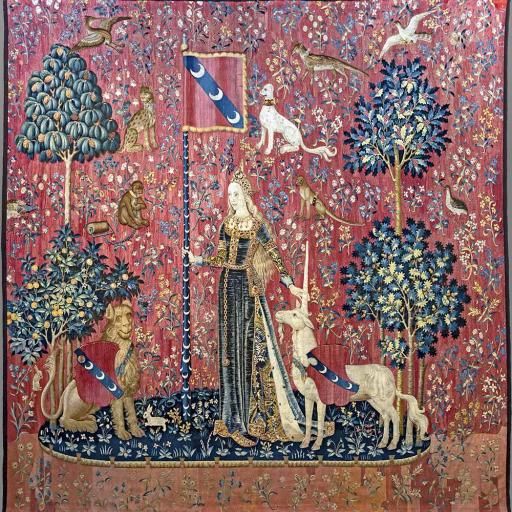
The Musée de Cluny is home to one of the most precious treasures in medieval art: the Lady and the Unicorn tapestries. These six hangings, woven at the very beginning of the 16th century, each represent one of the five senses, while a sixth scene has kept historians debating its meaning for generations. They serve as the natural centrepiece of the exhibition.
The final rooms turn to contemporary works, reflecting the myth's enduring vitality: the unicorn reimagined by Niki de Saint Phalle, and a 2020 Ukrainian military insignia that transforms it into a symbol of national resistance. This, it turns out, is a creature that never stops reinventing itself.
Not to Be Missed Around the Exhibition
- Lectures by historians throughout the spring, including an evening with Michel Pastoureau, leading specialist in medieval bestiaries, on 18 June
- Early music concerts in April and June, performed within the museum's galleries
- A costume ball on 13 June for those seeking full medieval immersion
- Workshops and storytelling tours designed for children aged 5 and up
Practical Information
- Open daily except Mondays, 9:30 am to 6:15 pm
- Late-night openings on the 1st and 3rd Thursdays of the month until 9:00 pm
- 25 minutes by public transport from Hotel FABRIC
Exhibition open until 12 July 2026 — Musée de Cluny, Paris 5th arrondissement.
Photo ©wikicommons